International Experts Sharing Meeting - Impact of Digital Currencies on Consumer Spending Patterns
Pasita
6/10/20265 min read
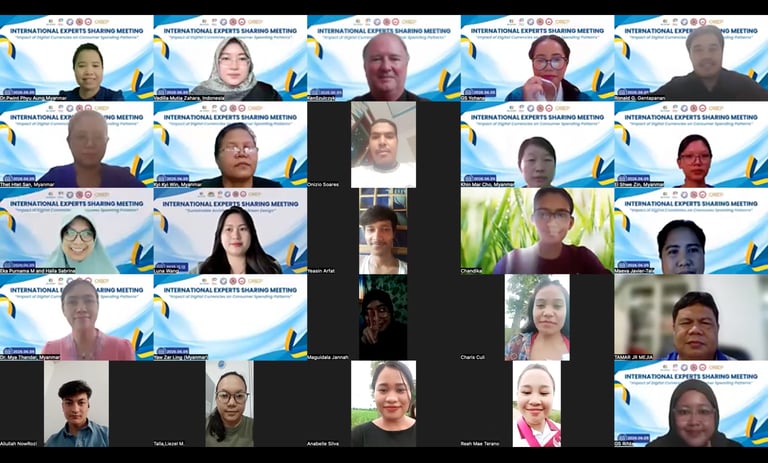
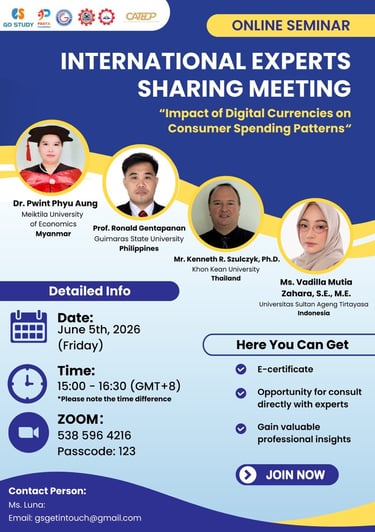
On the afternoon of June 5th, 2026, the 6th session of the “International Experts Sharing Meeting,” jointly organized by the China-ASEAN Technical Education Cooperation Platform (CATECP), the Southeast Asian Ministers of Education Organization Regional Centre for Technical Education Development (SEAMEO TED), and Go Study Global Education, was successfully concluded online. The meeting was attended by 42 male and 51 female participants, making a total of 93 participants.
Themed “Impact of Digital Currencies on Consumer Spending Patterns”, the meeting brought together experts and scholars from Myanmar, Phillipines, Thailand, and Indonesia. Discussions centered on cutting-edge topics including mobile fiat ecosystems in real estate, digital currencies and household consumption, Central Bank Digital Currencies (CBDCs), and digital payment dynamics in retail spending. These topics were explored through keynote speeches, case studies, and interactive exchanges.
【Opening Remarks】
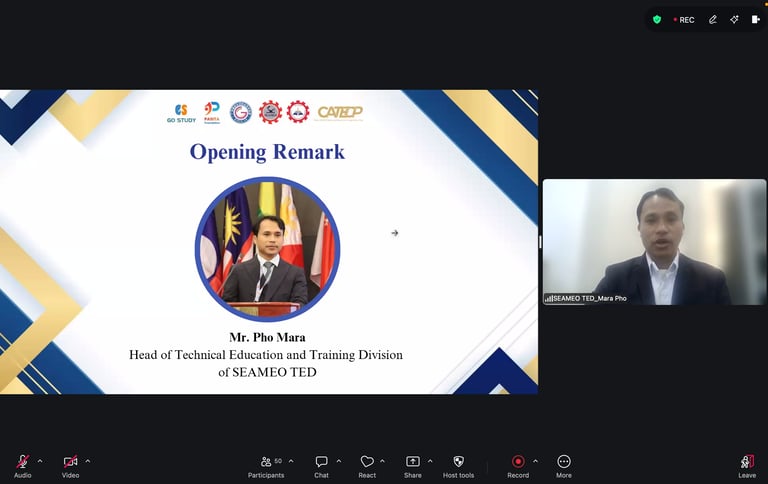
The opening remark was delivered by Mr. Pho Mara, Head of Technical Education and Training Division of SEAMEO TED. He began by welcoming the audience and highlighting that in today’s evolving digital economy, digital currencies are transforming the way people save, spend, and conduct transactions. He mentions that as this technology continues to develop, it is important for researchers, educators, policy makers, and industrial practitioners to understand the implications for consumer behavior, financial system, and economic development. Lastly, he encouraged the participants to engage openly and discuss the evolving landscape of digital payments, digital currencies, and financial inclusion, and to consider how these developments carry both opportunities and responsibilities for the ASEAN region and beyond.
【Sharing Session】
Speaker: Dr. Pwint Phyu Aung
Head of the Department of Applied Economics, Meiktila University of Economics, Myanmar
Topic: Analysis on Digital Currencies and Household Consumption Expenditure: China and Some Selected ASEAN Countries
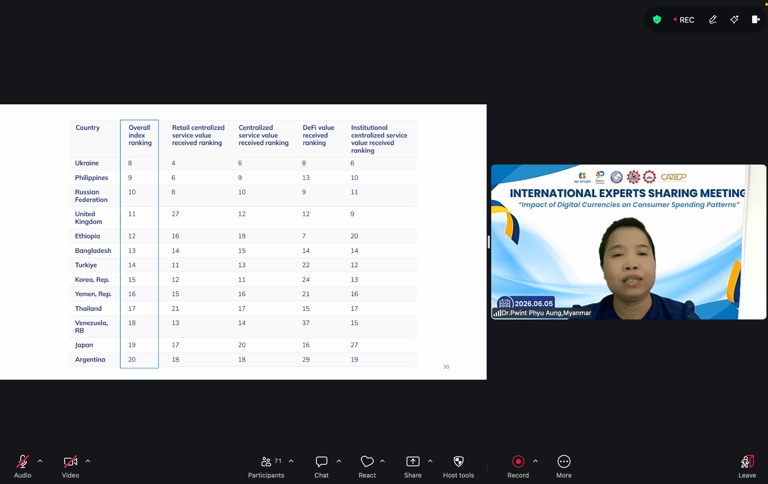
Dr. Pwint Phyu Aung from Meiktila University of Economics in Myanmar delivered a comprehensive presentation on the evolution of money and the implications of digital currencies for household consumption expenditure across China and selected ASEAN countries. She traced the historical development of payment systems from commodity money and fiat currency through to checks, electronic payments, and digital currencies, providing context for how financial innovation alters consumer behavior. She examined the major types of digital currencies including Central Bank Digital Currencies (CBDCs), cryptocurrencies, stablecoins, and utility tokens, and analyzed global trends in cryptocurrency adoption. One of the key points she raised is that when people feel wealthier, for example, when the value of their Bitcoin goes up they tend to spend more money. She finds that crypto wealth positively influenced consumption in China, Brunei, Malaysia, the Philippines, and Thailand, while the relationship was negative in Vietnam, Myanmar, and Cambodia. She explained these patterns through the wealth effect, and also highlighted how digital payment systems alter spending psychology, with non-cash transactions tending to encourage higher and more impulsive purchases compared to cash payments.
Speaker: Prof. Ronald Gentapanan
Professor of the College of Business and Management, Guimaras State University, Philippines
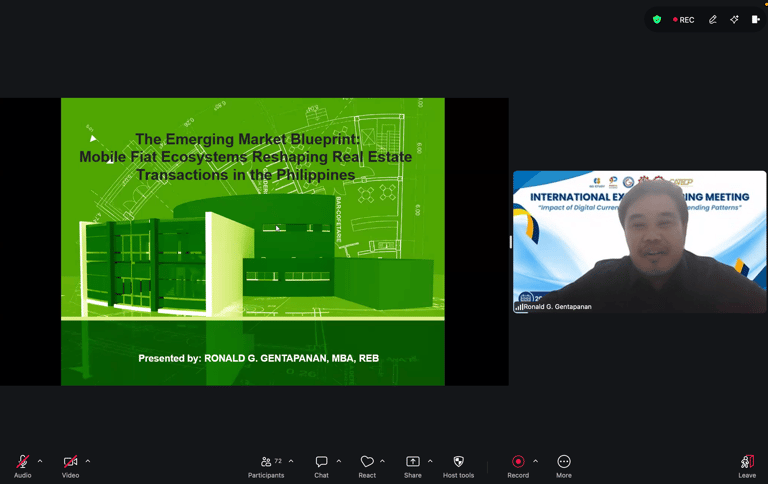
Topic: The Emerging Market Blueprint: Mobile Fiat Ecosystems Reshaping Real Estate Transactions in the Philippines
Prof. Ronald G. Gentapanan talked about how mobile payment apps are changing the way people buy and sell property in the Philippines. In the past, buying a home required going through banks and a lot of paperwork. Now, mobile platforms allow buyers to pay for property directly from their phones, making the process faster and easier. He also discussed how technology like smart contracts can automatically handle payments through escrow, and how Overseas Filipino Workers (OFWs) living abroad can now pay their property fees without being physically present. He noted that more people from the Philippines are using the internet and smartphones to search for homes, and that the market is growing because of urbanization and government support. Overall, he showed that mobile payment technology is reducing traditional banking delays and making real estate more accessible to more people.
Speaker: Kenneth R. Szulczyk, Ph.D.
Associate Professor, Khon Kaen University, Thailand
Topic: Building Trust for Central Bank Digital Currency (CBDC)
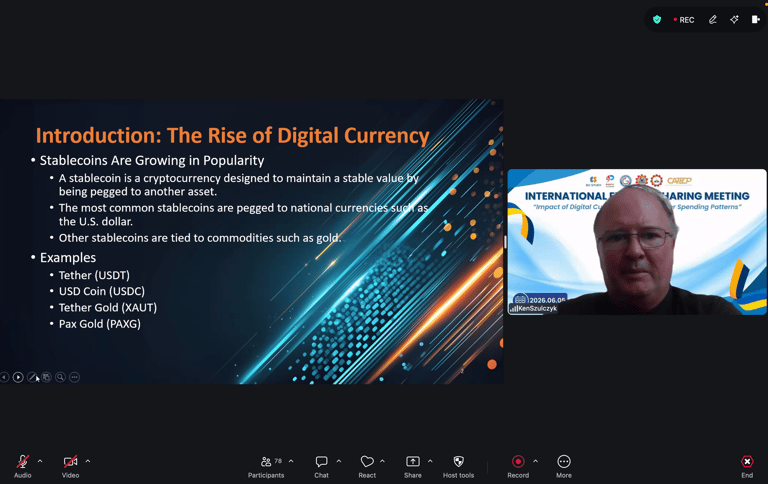
Mr. Kenneth R. Szulczyk explained the difference between Central Bank Digital Currencies (CBDCs) and private stablecoins, noting that stablecoins can be risky because they are not backed by governments and can suddenly lose their value, as seen in several past cases. CBDCs, on the other hand, are safer because they are officially issued and supported by a country's central bank. He discussed the potential benefits of CBDCs, such as making payments faster, reducing costs, and helping more people access banking services. However, he also raised important concerns, mainly around privacy and trust. He outlined potential benefits including faster payments, improved financial inclusion, and enhanced monetary sovereignty, while also presenting major concerns such as government surveillance, cybersecurity vulnerabilities, and the risk of programmable money enabling state control over individual spending. He proposed a citizen ownership model as a potential solution where citizens become stakeholders in national payment infrastructure, improving transparency and reducing perceptions of centralized control. He concluded that the long-term success of CBDCs depends not only on technological capability but fundamentally on public trust, institutional transparency, and sound governance.
Speaker: Vadilla Mutia Zahara, S.E., M.E.
Lecturer in Development Economics, Universitas Sultan Ageng Tirtayasa, Indonesia
Topic: Cashless but Not Cash-Free: Digital Payments and Retail Spending Dynamics in Indonesia
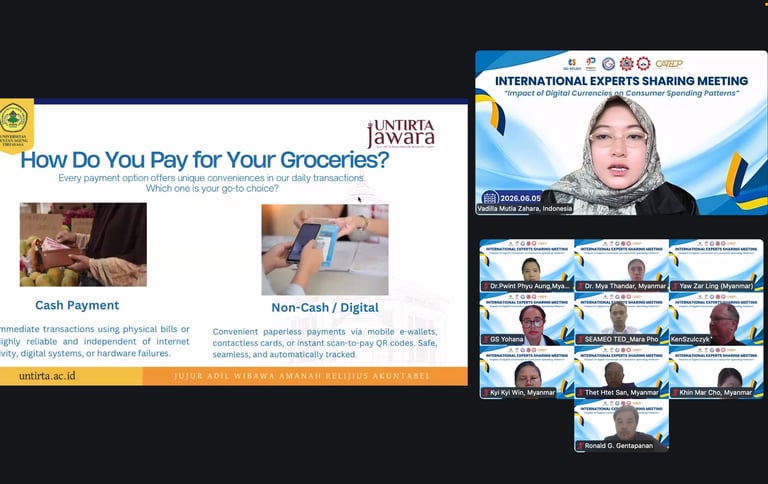
Vadilla Mutia Zahara looked at how digital payments are affecting retail spending in Indonesia. She found that while digital payments through tools like e-money, QRIS, and BI-FAST are growing rapidly, they mainly change how people pay, not how much they spend overall. In other words, digital payments replace cash, but they do not necessarily make people buy more things. She finds that broader economy actually drives spending, factors like money supply, consumer confidence, and seasonal events such as Ramadan and Eid al-Fitr, which cause a big rise in shopping. She also explained why Indonesia is unlikely to become fully cashless anytime soon. With more than seventeen thousand islands, many areas still lack reliable internet or electricity. A large part of the workforce is also in the informal sector, the dominance of the informal economy, and the cultural role of physical cash for unbanked and rural populations where the people mainly use cash. She concluded that Indonesia is moving toward a cashless-dominant economy, but cash will still be needed as a backup for those who cannot or do not want to use digital payments. Her recommendation is for policies that support digital growth while making sure no one is left behind.