International Experts Sharing Meeting - Integration & Optimization of Renewable Energy
Deskripsi blog
Pasita
5/13/20265 min read
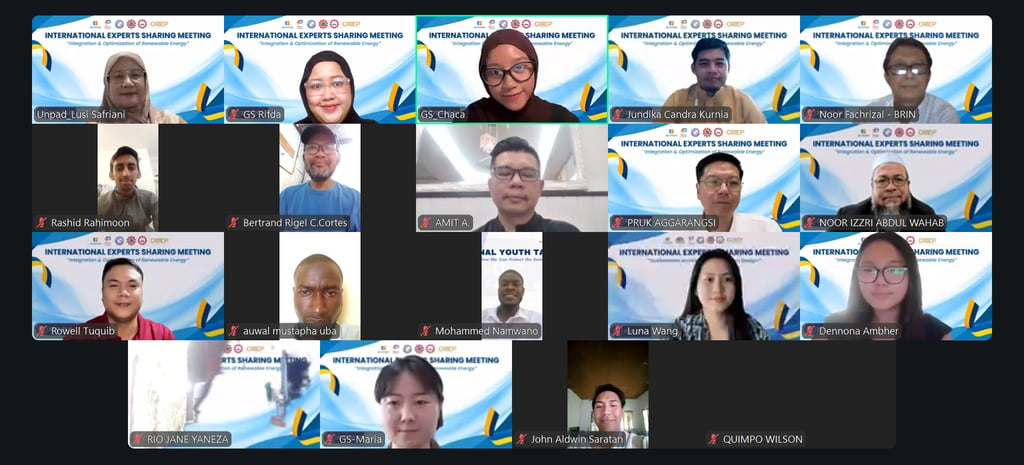
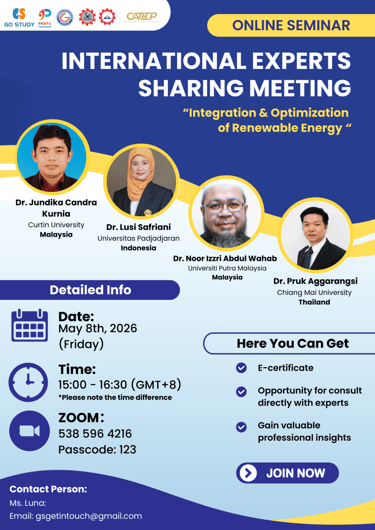
On the afternoon of May 8th, 2026, the 5th session of the “International Experts Sharing Meeting”, jointly organized by the China-ASEAN Technical Education Cooperation Platform (CATECP), the Southeast Asian Ministers of Education Organization Regional Centre for Technical Education Development (SEAMEO TED), and Go Study Global Education, was successfully concluded online. The meeting was attended by 58 male and 44 female participants, making a total of 102 participants.
Themed “Integration & Optimization of Renewable Energy”, the speakers are experts and scholars from Malaysia, Indonesia, and Thailand. Discussions centered on cutting-edge topics including solar energy technologies, AI-driven power system optimization, hydrogen vehicles, and clean energy production from food waste. These topics were explored through keynote presentations and interactive exchanges.
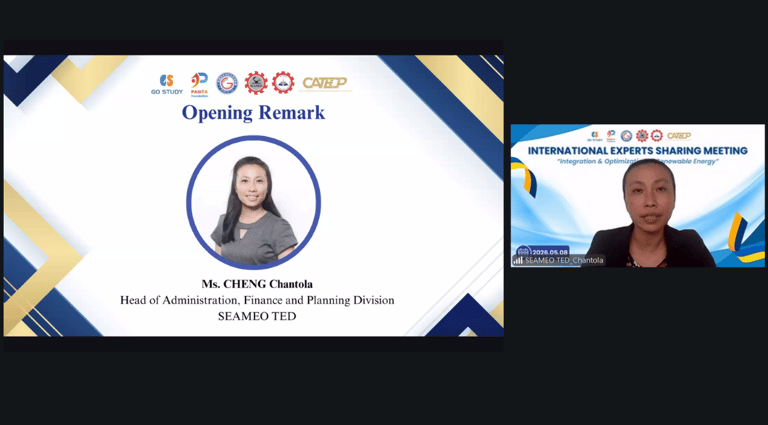
【Opening Remarks】
The opening remark was delivered by Ms. Cheng Chantola, Head of Administration, Finance and Planning Division of SEAMEO TED. She began by highlighting that as global demand for energy continues to rise, so does the urgency to transition toward cleaner and more sustainable sources. She emphasized that renewable energy has evolved beyond being merely an alternative — it is now becoming the backbone of our entire energy system. Ms. Cheng Chantola noted that the transition to a sustainable energy future goes well beyond simply expanding solar or other renewable capacities. It is increasingly a challenge of integration and optimization — particularly as the world moves away from steady and predictable fossil fuel sources toward variable renewable energy resources. She stressed that generating renewable energy is only half of the solution. The real challenge lies in how we effectively integrate these resources into existing infrastructure and optimize overall system performance to ensure reliability and efficiency. She concluded by warmly encouraging the participating experts, scholars, and youth representatives to actively share their experiences and perspectives, and to explore innovative educational and practical models for integrating and optimizing renewable energy systems across the region.
【Sharing Session】
Speaker: Dr. Pruk Aggarangsi
Assistant Professor in Mechanical Engineering, Chiang Mai University
Topic: Clean Energy from Food Waste, the Forgotten Resource: Case Study in Chiang Mai University
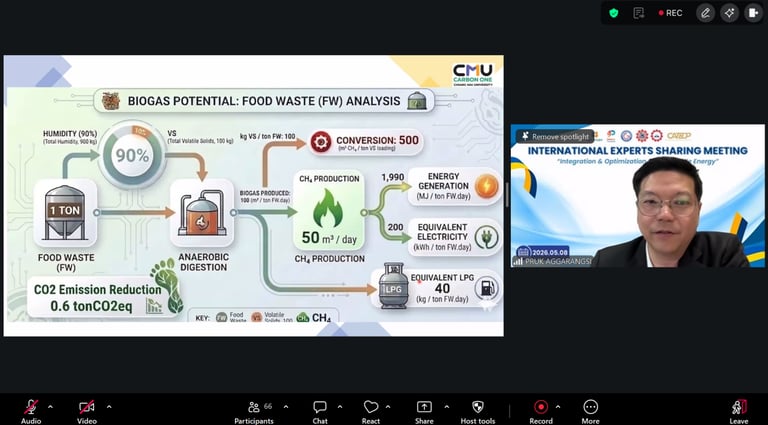
Dr. Pruk Aggarangsi from Chiang Mai University delivered an insightful presentation on Thailand’s biogas sector and CMU’s efforts in converting food waste and organic materials into clean energy. His presentation covered Thailand’s climate policy landscape, the development of biogas technology, and the large potential of food waste as a renewable energy source. He explained that food waste can be transformed into electricity, heat, compressed biomethane, and clean biomethane gas through anaerobic digestion while also helping to reduce greenhouse gas emissions. The presentation highlighted how biogas can serve as both an environmental management solution and a sustainable energy resource. In addition, he introduced several flagship projects developed by CMU that process farm waste, food waste, and agro-industrial residues into biogas on a large scale. He also discussed future developments such as Liquefied Biomethane production, digital platforms for food waste tracking, and Agri-Voltaic Farms that integrate integrate double use of land, recycling of compost from biogas system, and firming the supply with biogas generation. He concluded that biogas is both an environmental management tool and a clean energy resource, and that food waste remains a vastly underutilized opportunity in the region.
Speaker: Dr. Noor Izzri Abdul Wahab
Associate Professor in Department of Electrical and Electronic Engineering, Universiti Putra Malaysia
Topic: AI-Driven Integration and Optimization of Renewable Energy in Modern Power Systems
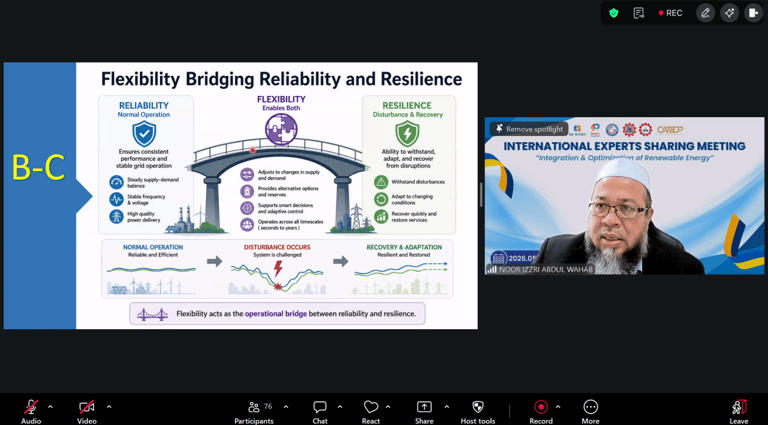
Dr. Noor Izzri presented on the application of Artificial Intelligence (AI) in optimizing renewable energy integration within modern power systems. He explained that the increasing use of intermittent renewable energy sources such as solar and wind creates several challenges, including intermittency, weather uncertainty, voltage instability, and frequency fluctuations. He described an AI architecture consisting of data sources, data processing, AI models, decision engines, and power system operations, which are applied in load forecasting, fault detection, grid balancing, and real-time control. In addition, he shared examples of AI-powered renewable integration programs through a Virtual Power Plant (VPP) system, integrating solar panels, wind turbines, batteries, and electric vehicles (EVs) with AI controllers and VPP platforms connected to the grid and energy market. Other technologies discussed included Edge AI, digital twins, and peer-to-peer (P2P) energy trading. He emphasized that these approaches can improve technical performance while reducing operational costs and carbon emissions. At the end of the presentation, he called for stronger collaboration among academia, industry, and policymakers to accelerate AI-driven energy transitions across ASEAN countries.
Speaker: Dr. Jundika Candra Kurnia
Associate Professor in Department of Mechanical Engineering, Curtin University
Topic: Hydrogen Vehicles in the Renewable Energy Transition: Barriers and Integration Pathways
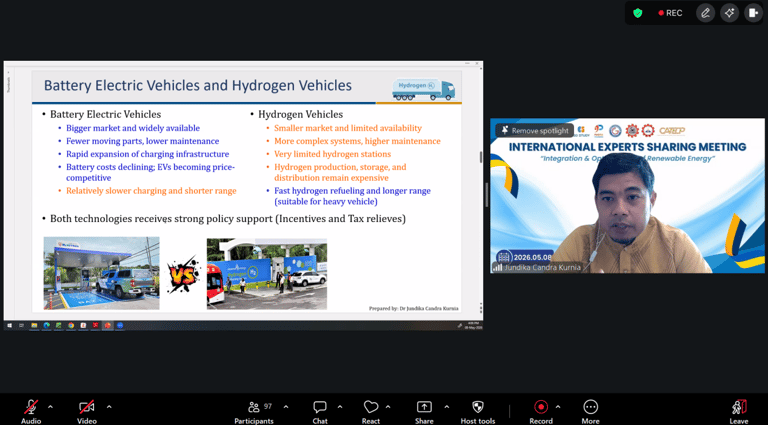
Dr. Jundika Candra Kurnia presented on hydrogen vehicles and their role in the global energy transition. He explained the shift from conventional internal combustion engine vehicles toward cleaner transportation technologies such as hybrid vehicles, Battery Electric Vehicles (BEVs), and hydrogen-fuelled vehicles. According to him, hydrogen vehicles offer advantages such as faster refuelling time and longer driving range, making them especially suitable for heavy transportation. During the presentation, he compared the strengths and limitations of BEVs and hydrogen vehicles in terms of charging time, infrastructure availability, maintenance, operational costs, and driving range. He also introduced two major hydrogen vehicle technologies: Hydrogen Fuel Cell Vehicles (HFCV) and Hydrogen Internal Combustion Engine Vehicles (HICEV). HFCVs were highlighted for their higher efficiency and zero NOx emissions, while HICEVs were presented as a more mature and lower-cost technology. In addition, he discussed several challenges that still hinder hydrogen vehicle adoption, including high production and infrastructure costs, limited refuelling stations, storage and catalyst management issues, and regulatory gaps. To address these barriers, he proposed several integration pathways such as expanding green hydrogen production, developing hybrid battery-hydrogen systems, and strengthening regional collaboration for infrastructure development. Overall, the presentation emphasized that hydrogen mobility has strong potential to support the renewable energy transition and reduce carbon emissions in the future transportation sector.
Speaker: Dr. Lusi Safriani
Associate Professor in Department of Physics, Universitas Padjadjaran
Topic: Innovative Energy Materials: Unlocking Solar Efficiency and Energy Storage
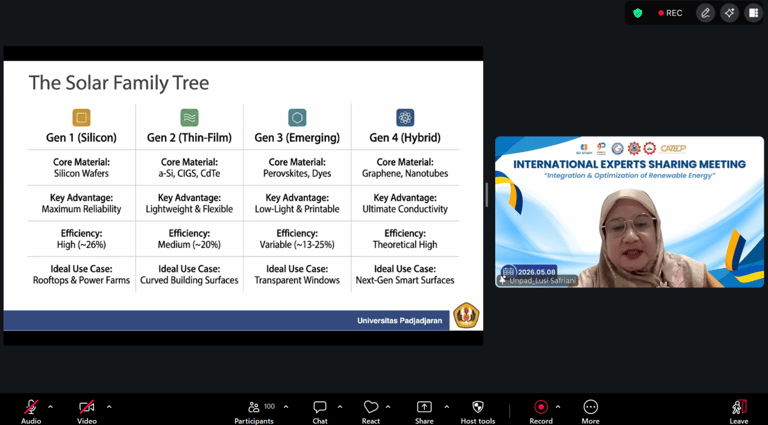
Dr. Lusi Safriani from Universitas Padjadjaran presented an interesting discussion about solar power technology and the development of Dye-Sensitized Solar Cells (DSSC) as an alternative renewable energy source. The presentation emphasized the importance of solar energy as a clean, renewable, and environmentally friendly energy solution that has strong potential for long-term sustainability. She explained that DSSC is a third-generation solar cell technology designed to imitate the natural process of photosynthesis in converting sunlight into electrical energy. Compared to conventional solar cells, DSSC offers several advantages such as lower production costs, better performance under low light conditions, wider light absorption angles, and longer operational durability. During the presentation, she also discussed the use of Zinc Oxide (ZnO) and Reduced Graphene Oxide (rGO) materials to improve DSSC performance. The addition of rGO layers helps accelerate electron transfer and reduce electron recombination, which can increase the efficiency of the solar cell system. In addition, the presentation described the fabrication and testing process of DSSC, including substrate preparation, rGO deposition, UV-oven treatment, and performance analysis using UV-Vis spectroscopy and photocurrent density-voltage testing. Overall, the presentation showed how advanced solar cell technologies can contribute to renewable energy development and support a more sustainable energy transition in the future.