International Youth Talk - How Practical Workshops Help Me Understand Engineering
Pasita
3/2/20264 min read
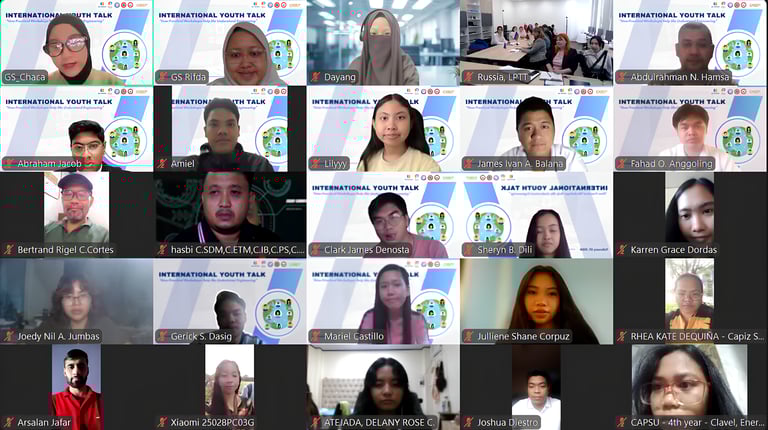
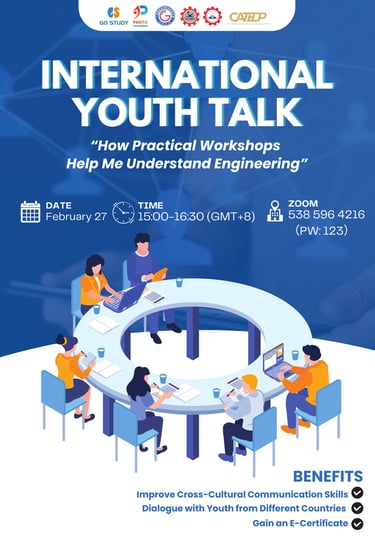
On the afternoon of February 27, 2026, the 13th session of “International Youth Talk,” co-organized by the Southeast Asian Ministers of Education Organization Regional Centre for Technical Education Development (SEAMEO TED), the China-ASEAN Technical Education Cooperation Platform (CATECP), with support from The Southeast Asia Youth Sustainable Development Foundation (PASITA), was successfully held online.
Youth representatives from universities across Russia, Malaysia, The Philippines, and Indonesia delivered insightful presentations. Focusing on the theme “How Practical Workshops Help Me Understand Engineering”, participants shared diverse perspectives on bridging theoretical knowledge with practical application, fostering cross-cultural dialogue and innovation in technical education.
01 Opening Remarks
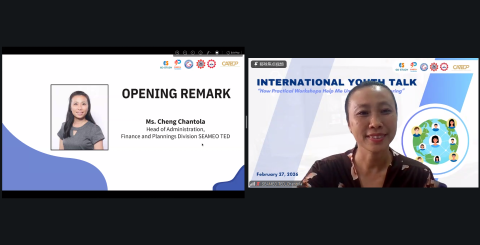
Ms. Cheng Chantola, Head of Administration, Finance and Plannings Division at SEAMEO TED, delivered the opening remarks. She emphasized that while engineering theory provides a foundation, it often remains abstract within textbooks. Practical workshops bridge this gap by allowing students to experience how theory functions in real life through “learning by doing.” She highlighted that hands-on activities help participants observe machine operations and system constructions. Furthermore, Ms. Chantola noted that this active learning process clarifies complex concepts, fosters creativity, and builds confidence by permitting students to learn from mistakes. Ultimately, she concluded that workshops transform engineering into tangible experiences, wishing everyone a fruitful discussion and learning journey.
02 Presentation Highlights
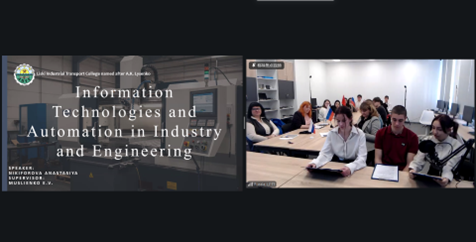
The team from Liskinsky Industrial and Transport College, Russia, explored how information technologies and automation shape modern engineering practice. They explained the three classic automation types—fixed, programmable, and flexible—and described the digital ecosystem connecting CAD/CAM design, MES workshop management, and ERP enterprise planning. The students highlighted Industry 4.0 trends such as Digital Twins and the Industrial Internet of Things, which enable predictive analytics and transparent production workflows. They acknowledged challenges including high implementation costs, the need for skilled personnel, and cyber security concerns. Regarding practical learning, the team emphasized that upcoming internships with CNC machines will bridge digital systems and real equipment operation. They concluded that embracing mistakes as learning opportunities fosters resilience and a growth mindset, preparing future specialists to handle the technical and adaptive demands of modern railway and industrial automation.
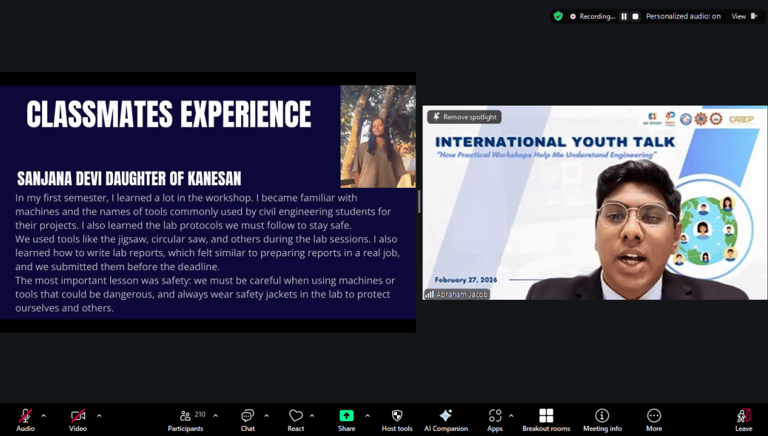
Mr. Abraham Jacob from Politeknik Sultan Haji Ahmad Shah, Malaysia, emphasized that practical workshops are essential for deepening engineering understanding. Citing that 83% of employers prefer graduates with hands-on skills, they highlighted common challenges including limited practical exposure and difficulty visualizing abstract concepts. He explained how experiential and active learning stimulate critical thinking, problem-solving, innovation, and technical adaptability aligned with 21st-century competencies. Mr. Jacob described how hands-on activities build tool handling skills, proper use of Personal Protective Equipment, and workplace safety awareness. Sharing personal experiences, students recounted transforming initial confusion in laboratory sessions into confidence through guided practice and protocol familiarity. He stressed that theory must be reinforced through real-world application to avoid poor decision-making and communication gaps. Looking forward, Mr. Jacob suggested future engineering workshops should integrate digital fabrication, Industry 4.0 technologies, virtual reality training, and sustainability practices to better prepare students for professional engineering environments.
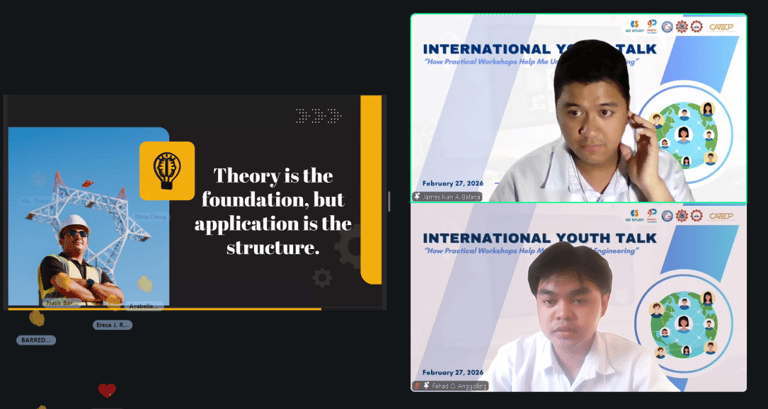
The team from Capiz State University, The Philippines, examined where engineering understanding truly develops by contrasting classroom settings with on-site applications. They explained that while classrooms focus on abstract concepts and neat equations, real-world practice requires judgment, improvisation, and teamwork when conditions diverge from assumptions. Safety, they noted, shifts from conceptual discussion in class to rigorous enforcement on-site where mistakes can cause accidents. Collaboration expands from individual exercises to large, multidisciplinary teams with complex communication needs, and outcomes evolve from correct answers on paper to functioning structures meeting codes, budgets, and community needs. Describing their emotional journey, the team shared how initial confusion, doubt, and pressure before workshops transformed into confidence as they realized every measurement and detail counts. They concluded that engineering is not merely learned but experienced, emphasizing that it carries a responsibility to create and serve, reminding students that the profession demands both technical precision and social commitment.
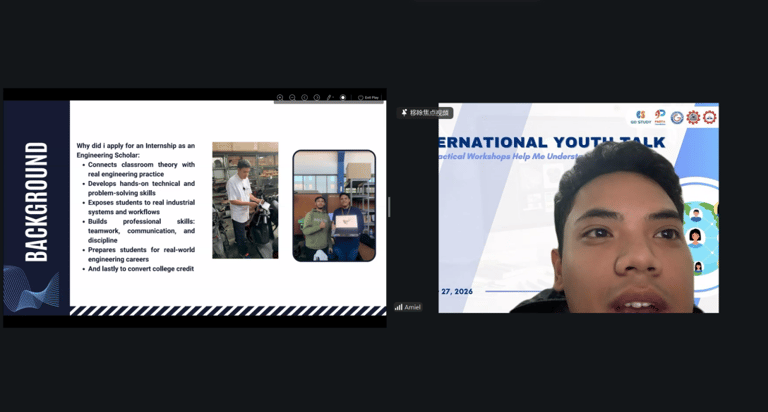
Mr. Amiel Abhinandana Mulyanegara from Institut Teknologi Nasional Bandung (ITENAS), Indonesia, presented his internship experience as a transformative bridge between classroom theory and real engineering practice. He explained that internships develop hands-on technical skills, expose students to industrial systems and workflows, and build professional competencies including teamwork, communication, and discipline. At PT LEN Industri, a state-owned enterprise specializing in electronic systems for transportation and defense, he served as a Project Assistant within the Project Deployment Center. His activities included project administration, documentation, electric motorcycle maintenance, logistic preparation, and testing and monitoring. He emphasized that this experience strengthened his technical analysis abilities and expanded his professional network. Concluding his presentation, Mr. Amiel stated that internships are not merely graduation requirements but journeys that turn knowledge into real impact, shape professional character, and inspire the confidence to become future engineers ready to innovate, solve real-world problems, and contribute meaningfully to society.