Summary of the June 2026 International Perspectives Webinar Series
Pasita
7/3/20262 min read
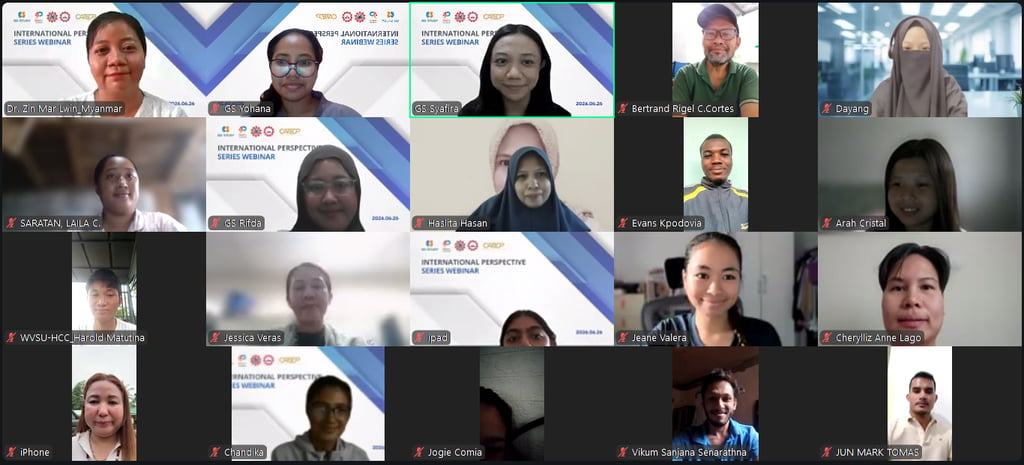
The June sessions of The International Perspectives Webinar Series were successfully conducted. The event was co-organized by the China–ASEAN Technology Education Cooperation Platform (CATECP), the SEAMEO Regional Centre for Technical Education Development (SEAMEO TED), with support from PASITA. This month’s webinars took place on June 12 and 26, 2026, featuring senior experts from Universiti Putra Malaysia and Mandalay Technological University.
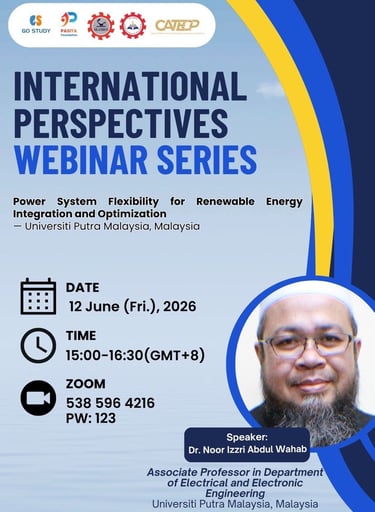
Webinar 1
Topic: Power System Flexibility for Renewable Energy Integration and Optimization
Speaker: Dr. Noor Izzri Abdul Wahab, Associate Professor in Department of Electrical and Electronic Engineering at Universiti Putra Malaysia
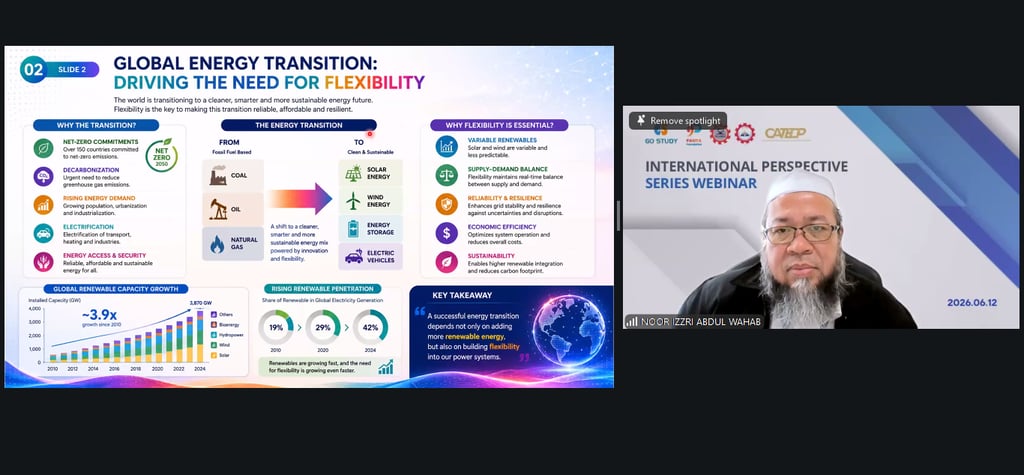
In his presentation, Dr. Noor Izzri Abdul Wahab explained about power system flexibility as the critical catalyst for enabling a reliable, resilient, and sustainable renewable energy future. He began by highlighting the global energy transition, noting that while rapid growth in solar and wind capacity drives decarbonization, it also introduces steep operational challenges. These hurdles include severe supply-demand mismatches, grid instability, and the prominent "duck curve" phenomenon, which demands rapid ramping capabilities due to solar power variability. To mitigate these issues, he defined power system flexibility as the capability to respond to variability and uncertainty across multiple operational time scales. He detailed key flexibility resources on both the supply and demand sides, highlighting energy storage systems, demand response programs, grid flexibility enhancements, and Virtual Power Plants (VPPs). Furthermore, he outlined advanced frameworks for quantifying, modeling, and optimizing flexibility through AI, machine learning, and market mechanisms. Finally, he provided practical context by reviewing energy transition pathways, policies, and flexibility assessments using case studies from Thailand and Malaysia. He concluded that a multi-dimensional approach combining data, infrastructure, and regional cooperation is vital for a sustainable energy future.
Webinar 2
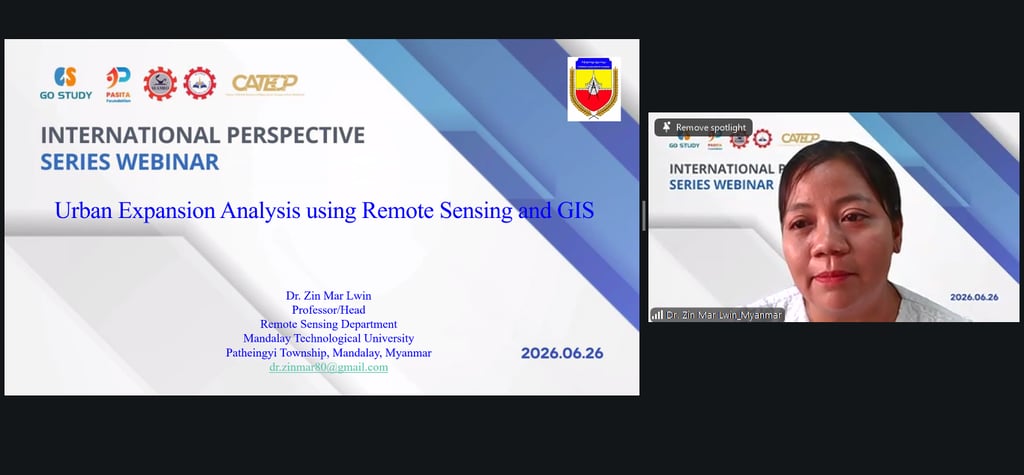
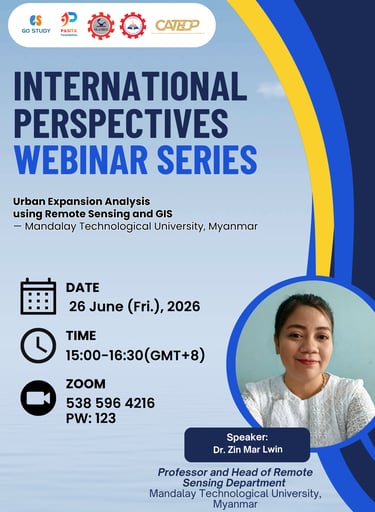
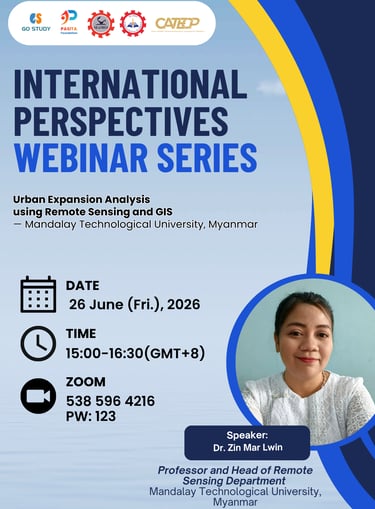
Topic: Urban Expansion Analysis using Remote Sensing and GIS
Speaker: Dr. Zin Mar Lwin, Professor and Head of Remote Sensing Department at Mandalay Technological University
In her presentation, Dr. Zin Mar Lwin explained the urban expansion analysis of Mandalay, Myanmar, using Remote Sensing (RS) and GIS techniques. She highlighted how tracking urban growth over time provides an essential spatial framework to address challenges stemming from rapid population growth and infrastructure development. The study monitored the city's growth over a ten-year period from 2015 to 2025 using multi-temporal Landsat 8 satellite imagery. To extract built-up areas, the methodology compared the Normalized Difference Built-Up Index (NDBI) index and Maximum Likelihood Supervised Classification to categorize data into thematic Land Use/Land Cover (LULC) maps. The analysis revealed that Mandalay's built-up area expanded from 94.98 km² in 2015 to 101.05 km² in 2020, eventually reaching 112.29 km² by 2025. This structural growth raised the urban footprint from 22.69% to 26.83% of the studied region. She concluded that these remote sensing findings deliver a vital quantitative baseline for sustainable urban land use planning and environmental management.